SOC for small and mid-sized companies: 24/7 monitoring explained
Understand how a 24/7 Security Operations Center (SOC) protects German SMEs, ensures NIS2 compliance, and why managed security is the optimal approach.
The growing cyber threat to German Mittelstand companies
Small and mid-sized companies in Germany are now squarely in the crosshairs of international cybercriminals. The days when hackers primarily targeted large corporations are over. According to the economic protection study by the digital association Bitkom, around 81 percent of all German companies were affected by data theft, espionage, or sabotage in 2024. The resulting record damage to the German economy reached an enormous 266.6 billion euros. Cyberattacks account for around two thirds of this total damage and increasingly threaten the very existence of the Mittelstand.
It is particularly alarming that 65 percent of companies now see cyberattacks as a threat to their existence. Yet many managing directors and IT leads still rely on outdated security concepts. A simple combination of a classic firewall and conventional antivirus software no longer offers adequate protection against modern, automated attacks. A basic antivirus solution cannot stop highly targeted ransomware campaigns.
Automated ransomware and vulnerable supply chains
Modern malware operates in a highly automated way and probes the network around the clock for the smallest security gaps. As soon as a breach succeeds, the infection spreads at lightning speed. A typical incident shows how devastating the consequences of ransomware can be for business operations when all systems are encrypted. The supply chains of German companies are also moving ever more sharply into the attackers' focus. Because smaller suppliers often have weaker security measures in place, they frequently serve cybercriminals as a gateway to the actual primary target further up the supply chain.
| Security aspect | Classic defense | Active 24/7 SOC monitoring |
|---|---|---|
| Response time | Reactive after discovery (often days or weeks) | Real-time detection and immediate isolation (minutes) |
| Attack coverage | Only known malware via signatures | Behavior-based EDR analysis for zero-day exploits |
| Operating hours | Only during regular office hours | Seamless monitoring around the clock (24/7) |
To counter these sophisticated threats effectively, continuous monitoring is indispensable. Modern cybersecurity requires an active Security Operations Center (SOC) that detects and isolates suspicious activity immediately. CAVRIX cybersecurity gives mid-sized companies exactly this kind of seamless 24/7 monitoring, so you can fend off threats and reliably meet your legal obligations.
What is a Security Operations Center (SOC) and how does it work?
A Security Operations Center (SOC) acts as the central defense hub for a company's entire digital infrastructure. While conventional security measures often rely solely on passive protection, a modern SOC continuously monitors all networks, servers, and endpoints in 24/7 operation[1]. For managing directors and IT leads in the German Mittelstand, this seamless monitoring is decisive, because cyberattacks today are mostly automated and take place outside regular working hours. A professional SOC closes this security gap by analyzing and fending off suspicious activity immediately.
The continuous monitoring cycle
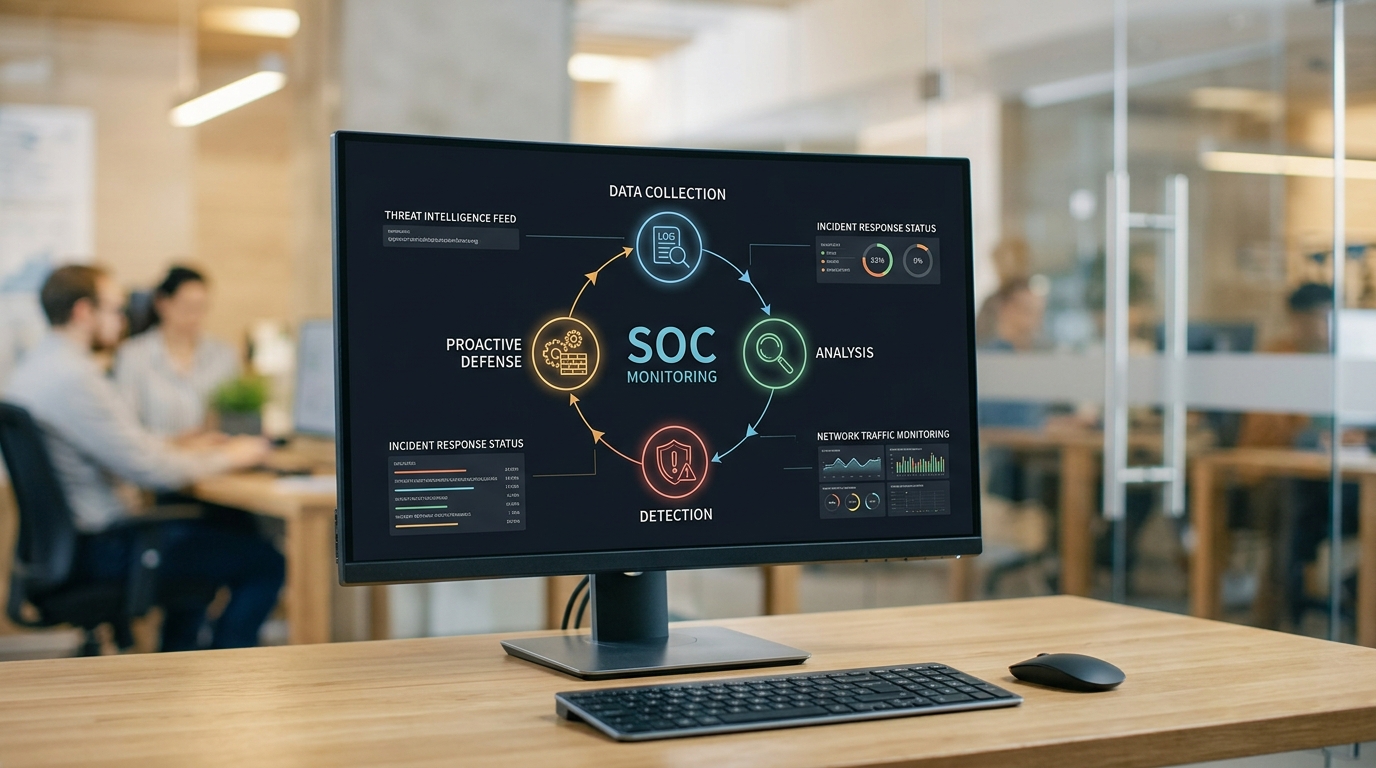
The way a SOC works can be described as an ongoing cycle made up of data collection, threat detection, incident analysis, and proactive response. First, specialized systems such as SIEM (Security Information and Event Management) and EDR (Endpoint Detection and Response) collect logs and activity data from across the entire organization. Algorithms analyze this data in real time to detect anomalies. As soon as a potential threat is identified, the system raises an alert, whereupon qualified security analysts begin their investigation immediately[1].
| Security approach | Focus | Incident response time | Real-time visibility |
|---|---|---|---|
| Passive defense | Prevention of known threats | Delayed (often only after a system outage) | Limited to local logs |
| Active 24/7 monitoring (SOC) | Detection of anomalies and zero-day exploits | Immediate (containment within minutes) | Complete via central dashboards |
This active approach stands in clear contrast to outdated methods. Conventional antivirus solutions are therefore long past being sufficient to secure complex networks. A modern SOC is able to detect even sophisticated attacks that slip past classic filters. The rapid isolation of affected systems prevents threats from spreading across the entire network, which is especially important to effectively stop devastating ransomware attacks before important data is encrypted.
For mid-sized companies, building an in-house SOC is usually unrealistic given the enormous costs and the shortage of skilled staff. Integrating a professionally managed service such as CAVRIX cybersecurity offers an economical and reliable alternative here. By seamlessly combining state-of-the-art technology with human expertise, CAVRIX ensures seamless monitoring. Through the Command Center you keep your company's security posture in view at all times and can act directly within your familiar communication channels. This secures your processes while at the same time meeting the strict legal compliance requirements.
Why 24/7 monitoring is essential for NIS2 compliance
The European NIS2 directive drastically tightens the cybersecurity requirements for the German Mittelstand. Many small and mid-sized companies with fewer than 500 employees must now demonstrate that they have adequate risk management measures in place. A central component of these legal obligations is the proactive detection and immediate handling of IT security incidents. Companies therefore have to check proactively whether they fall under the regulation (see also whether NIS2 applies to you).
The biggest day-to-day hurdle is the extremely tight time window for the reporting obligation. As soon as a significant security incident is identified, an unforgiving deadline starts to run. Without seamless 24/7 monitoring by a professional Security Operations Center, it is practically impossible for mid-sized IT teams to meet these legal reporting stages on time, because attacks usually happen at night or on the weekend.
| Reporting stage | Deadline after becoming aware | Content and purpose of the report |
|---|---|---|
| Early initial report (early warning) | Within 24 hours | Initial assessment of the incident and indication of whether there is suspicion of an unlawful act. |
| Update / follow-up report | Within 72 hours | More precise details, an initial damage assessment, and the provision of indicators of compromise. |
| Final report | After 1 month at the latest | Detailed final report including root-cause analysis and long-term remediation measures. |
The personal liability of management in focus
A key aspect of the new legislation concerns the responsibility of the company's governing bodies. Managing directors and IT leads can no longer simply hand over responsibility for IT security to external partners without coming into the authorities' focus themselves. This also includes the personal liability of management for complying with the due-diligence obligations under Section 38 BSIG. Violations carry the risk of substantial fines and personal liability for management.
To meet these legal requirements reliably and without setting up an extremely expensive in-house night shift, CAVRIX offers a pragmatic way out. The Cybersecurity and Compliance services are aligned with the strict NIS2 requirements from day one. As an all-in-one platform operated by CITO GmbH in Hamburg, CAVRIX delivers seamless 24/7 monitoring with audit-proof reports. This gives mid-sized businesses exactly the tools they need for seamless NIS2 compliance and the protection of their infrastructure.
The high cost of an in-house SOC vs. managed services
Building your own Security Operations Center (SOC) in house presents mid-sized companies in Germany with immense financial and organizational challenges. Given the rapidly growing threat from ransomware and ever-stricter legal requirements, continuous 24/7 monitoring of the IT infrastructure is long past being an option and has become an absolute necessity. Yet many managing directors and IT leads underestimate the immense effort involved in running such a security hub on their own. Anyone who tries to deliver round-the-clock protection with the conventional capacity of an internal IT team quickly runs into dangerous limits. Professional attackers prefer to use weekends, public holidays, or the dead of night, when internal IT specialists are usually off duty.
The biggest cost driver of an in-house SOC is the enormous staffing requirement. To ensure seamless monitoring around the clock 365 days a year, assigning one or two employees to security tasks is far from enough. Taking into account shift work, vacation periods, public holidays, and sick leave, a fully fledged 24/7 operation realistically requires at least 6 to 9 full-time staff working exclusively as security analysts[2]. At the going salaries for specialized cybersecurity staff in Germany, this leads to annual personnel costs that far exceed the budget of most mid-sized companies with fewer than 500 employees.
Staffing crisis and technological hurdles
Beyond the direct salary costs, the acute shortage of skilled staff makes the situation dramatically worse. Qualified security analysts are in extremely high demand on the German labor market, which makes recruiting and retaining experts over the long term a lengthy and costly undertaking. On top of this come substantial investments in the technological infrastructure. A professional SOC needs sophisticated SIEM systems for event analysis as well as modern Endpoint Detection and Response (EDR) solutions for the proactive defense against threats. Acquiring software licenses, the complex system integration, and continuous maintenance quickly add up to six-figure sums, before the first security incident has even been analyzed. Anyone who wants to dig deeper into the financial aspects of modern IT models will find valuable financial comparisons in our guide to managed IT costs.
| Criterion | In-house SOC | Managed SOC (e.g. CAVRIX) |
|---|---|---|
| Staffing effort | At least 6 to 9 full-time staff required for 24/7 shift operation. | No in-house staff needed; monitoring runs entirely externally. |
| Investment costs | Very high for infrastructure, software licenses, and integration. | Predictable and low thanks to direct use of an established platform. |
| Technology stack | Self-managed procurement and continuous upkeep of SIEM and EDR. | State-of-the-art security software is already natively included in the service. |
| Scalability | Sluggish; expanding staff and technology is extremely time-consuming and costly. | Maximum flexibility; easy adaptation to changing company structures. |
A far more economical and immediately ready-to-use alternative is to outsource to a specialized provider. With the Cybersecurity service, CAVRIX provides mid-sized companies with a fully fledged, AI-native 24/7 Security Operations Center, without having to build up expensive staff or launch lengthy software projects. Monitoring runs fully automatically in the background, while the experienced team at CITO GmbH in Hamburg intervenes immediately in an emergency. Thanks to transparent, predictable prices per user or device, IT security stays calculable, while at the same time your company meets all strict legal requirements from day one and enjoys optimal protection against modern ransomware attacks.
How CAVRIX simplifies cybersecurity and compliance for the Mittelstand
The threat landscape in the digital space remains a constant challenge for German companies. According to the latest situation report by the Federal Office for Information Security (BSI), the situation continues to be tense and worrying, with an average of around 78 new IT vulnerabilities discovered every day[3]. For managing directors and IT leads in small and mid-sized enterprises (SMEs), this means an enormous workload. Securing your own infrastructure usually requires the tedious management of countless individual solutions and various external IT service providers. This frequently leads to security gaps, communication problems, and high operating costs.
CAVRIX resolves this complexity through a holistic approach. As a fully integrated platform, the Hamburg-based provider brings all the essential pillars of modern corporate IT together under one roof: Managed IT, Cybersecurity, Compliance, and the intuitive Command Center. Operated by CITO GmbH in Hamburg, you get a single, central point of contact for your entire IT infrastructure. You no longer have to deal with different contacts for support, IT security, and regulatory matters, which dramatically simplifies the management of your systems and conserves internal resources.
Integrated protection and NIS2 readiness from day one
The regulatory requirements for mid-sized businesses are rising steadily, especially with regard to European security rules. To meet the legal obligations while at the same time minimizing the personal liability of management, a structured implementation is essential. This is where the integrated module from CAVRIX comes in: with pre-configured security and documentation processes, your operation is prepared from day one to comply with the strict requirements. Through the close integration of Managed IT and automated audit logs, you receive the support you need to achieve the required NIS2 compliance without costly external consulting.
| Criterion | Classic multi-vendor approach | Unified CAVRIX approach |
|---|---|---|
| Point of contact | Multiple providers and unclear handoffs when IT problems arise | A single point of contact (CITO GmbH in Hamburg) for the entire infrastructure |
| System silos | Fragmented tools for support, protection, and documentation | Seamless integration of Managed IT, Cybersecurity, and Compliance |
| NIS2 requirements | Tedious, retroactive adaptation of IT processes to the rules | Integrated, legally sound standard processes from day one |
| Operational transparency | Confusing portals or long waits for ticket updates | Real-time visibility and direct control via the Command Center |
Real-time transparency in the Command Center and 24/7 monitoring
So that you always stay on top of things, the Command Center offers a modern interface to your IT security. Instead of having to work through complex dashboards or technical reports, IT leads and managing directors can view the current security status and upcoming tasks within everyday communication tools such as Microsoft Teams or Slack. This transparency is complemented by continuous 24/7 threat monitoring in the background. Should anomalies or potential cyberattacks be detected, the security experts intervene immediately to neutralize the threat before it causes damage. In this way, CAVRIX combines state-of-the-art cybersecurity for the Mittelstand with maximum operational simplicity.
Frequently asked questions
What is a Security Operations Center (SOC)?
A SOC is a centralized team of cybersecurity experts that continuously monitors an organization's IT infrastructure, endpoints, and servers to detect, analyze, and respond to security incidents in real time, preventing threats before they cause damage.
Is 24/7 monitoring mandatory for NIS2 compliance in Germany?
While the regulation does not explicitly name a SOC, it mandates risk management measures, rapid detection of incidents, and quick warning reports. In practice, achieving the required early-warning detection and reporting within 24 hours is nearly impossible without continuous 24/7 monitoring.
Which German companies are affected by NIS2?
Broadly, NIS2 affects organizations in critical sectors that have at least 50 employees or an annual turnover of 10 million euros. These companies must implement strict cybersecurity frameworks or face substantial penalties.
What are the main costs associated with building an in-house SOC?
Setting up an internal SOC is highly expensive. Beyond software licensing and infrastructure, it requires at least five to six dedicated security analysts to cover a 24/7 schedule, resulting in operational costs that easily exceed euros per month
How does Managed SOC differ from an internal SOC for SMEs?
Managed SOC outsourcing provides small and mid-sized companies access to shared security infrastructure and experts. Instead of massive internal investments, SMEs pay a predictable fee, often between 100 and 500 euros per user annually, while receiving the same elite-level security.
Who operates CAVRIX and where is it based?
CAVRIX is operated by CITO GmbH, based in Hamburg, Germany. This ensures that all IT, cybersecurity, and compliance operations are conducted under strict European data protection standards and managed by local experts who understand the German Mittelstand.